Folk High Schools Advancing Sustainable Development and Global Citizenship
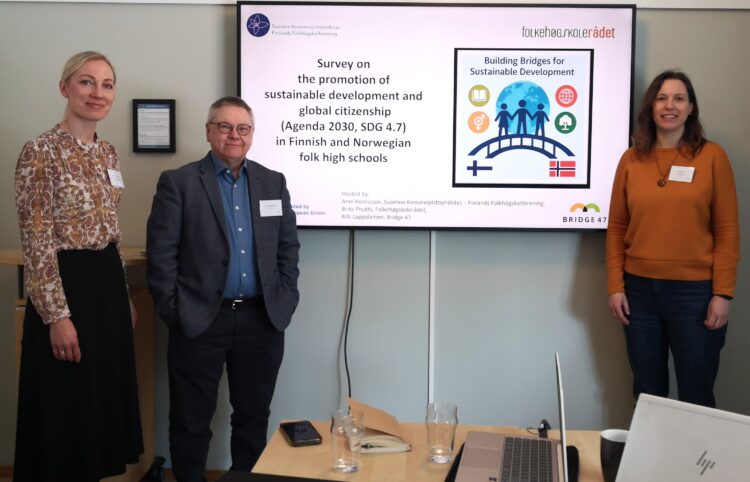
New report highlights strong commitment – and different national strengths – in Finland and Norway
A new Finnish–Norwegian report examines how folk high schools promote sustainable development and global citizenship in line with the UN’s Sustainable Development Goal 4.7 (SDG 4.7). Based on survey responses from over half of all folk high schools in both countries, the study shows a strong shared commitment to sustainability, alongside clear differences in emphasis, implementation and development needs.
A new Finnish–Norwegian report examines how folk high schools promote sustainable development and global citizenship in line with the UN’s Sustainable Development Goal 4.7 (SDG 4.7). Based on responses from over half of the schools in both countries, it highlights a strong commitment to sustainability alongside differences in implementation and development needs.
Sustainability Is Embedded in Everyday Education
In both Finland and Norway, sustainability is not treated as a separate theme but as part of the core mission of folk high schools. Teaching widely covers human rights, environmental responsibility, sustainable lifestyles and solidarity.
Finnish folk high schools stand out for their strong pedagogical integration of sustainability:
- Human rights, gender equality and environmental responsibility are each included in teaching at around 94 % of schools.
- Cultural diversity is also highly visible.
Norwegian folk high schools place particular emphasis on:
- Climate and environmental responsibility
- Sustainable lifestyles
- Global citizenship and solidarity
Global citizenship is more strongly emphasised in Norway, while gender equality and peace education are more prominent in Finland.
Different Teaching Approaches, Shared Values
Teaching methods in both countries rely heavily on discussion and critical reflection. However, approaches differ:
- Finland emphasises experiential learning, nature education, futures thinking and sustainability as part of everyday school life.
- Norway relies more on project-based learning and cooperation with local communities, organisations and partners.
Both models support active citizenship, but through different pedagogical traditions.
Environmental Action: Common Foundations, Different Focus
Basic environmental measures – such as waste sorting, vegetarian food options, reducing food waste and saving energy – are widely implemented in both countries.
Differences emerge in focus:
- Finland highlights biodiversity, cultural landscapes, traditional skills and nature-based learning as part of environmental education.
- Norway emphasises climate mitigation, energy efficiency, technical solutions and sustainable food systems, including self-sufficiency projects.
Environmental sustainability in Finland is closely linked to pedagogy and community practices, while in Norway it is more often connected to climate policy and infrastructure solutions.
Social and Cultural Sustainability
Social sustainability is strong in both systems, but with different emphases:
- Finnish schools prioritise equality, inclusion, participation and community-building through pedagogy.
- Norwegian schools focus on student well-being, safety and prevention of social exclusion.
Cultural sustainability – especially diversity and tolerance – is well supported in both countries. However, cultural accessibility, including language sensitivity and participation structures, is identified as a key area for further development.
Key Challenges and Development Needs
Despite strong commitment, sustainability work is not yet fully systematic.
- In Finland, the main challenge is lack of resources, particularly staff time and funding.
- In Norway, challenges relate more to staff competence, motivation and uneven prioritisation.
Both countries call for:
- Practical, ready-made teaching materials
- Lighter evaluation and assessment tools
- Staff training and leadership support
- Stronger cooperation, peer networks and shared projects
Conclusion
The report concludes that Finnish and Norwegian folk high schools play a vital role in advancing sustainable development and global citizenship. Their work is already extensive and impactful, but stronger structures, resources and cooperation are needed to move from project-based efforts to long-term, systemic impact.
As living communities of learning, folk high schools demonstrate how sustainability can be taught not only as knowledge – but as everyday practice.
Text: Rilli Lappalainen, CEO of Bridge 47

The study was conducted as part of the Building Bridges project, an Erasmus+ initiative funded by the European Union and carried out in cooperation between Finnish and Norwegian folk high schools. The project focuses on advancing sustainable development and global citizenship (SDG 4.7) by supporting the sharing of good practices, providing comparative insights, and promoting the long-term development of sustainability work in folk high schools.